
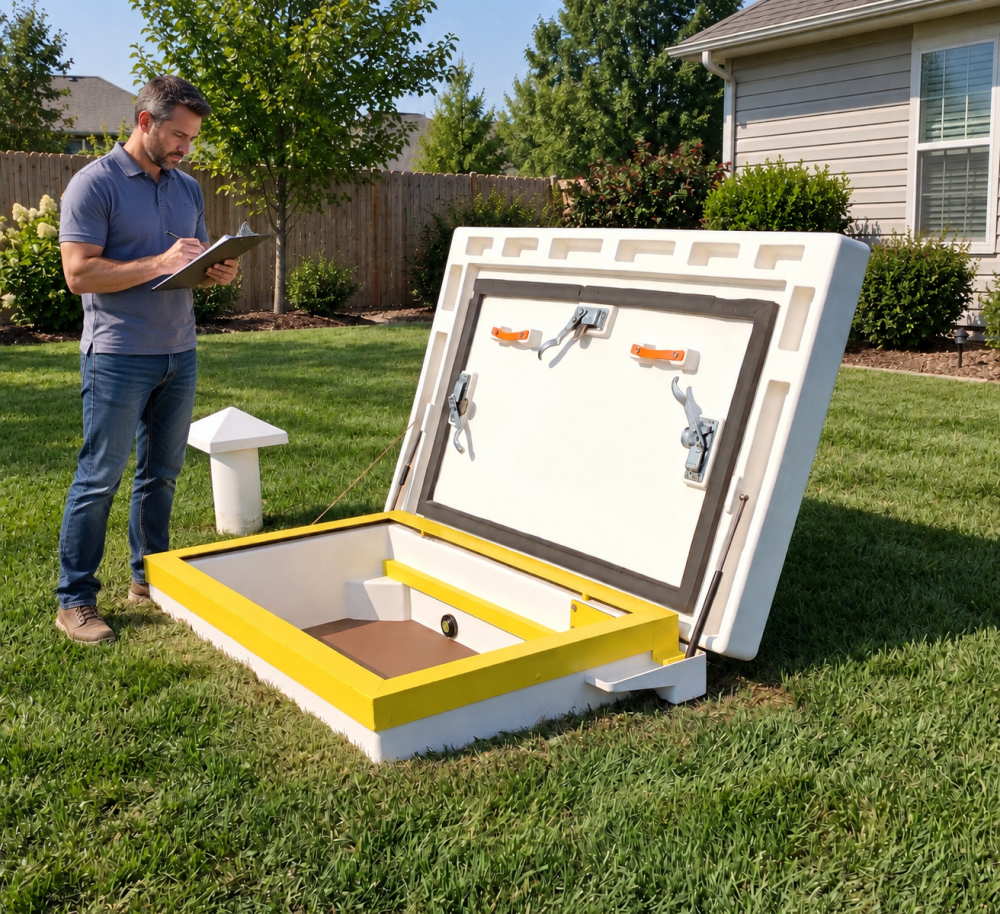
When shopping for a tornado shelter or storm shelter, homeowners may encounter phrases such as “ICC 500 compliant,” “FEMA compliant,” “tornado rated,” “tested” or even “FEMA approved.”
Those phrases can sound similar. They are not necessarily interchangeable.
For a homeowner making a safety-related purchase, the important question isn't simply whether a shelter looks strong or whether an advertisement uses reassuring terminology.
What standards, engineering, testing and documentation actually support the claims being made about the shelter?
Important: FEMA does not endorse, approve, certify or recommend individual tornado shelter products, contractors or manufacturers. Homeowners should be cautious when encountering claims that a particular product or company is “FEMA approved” or “FEMA certified.”
What Is ICC 500?
ICC 500 is the ICC/NSSA Standard for the Design and Construction of Storm Shelters. It establishes minimum requirements for the design, construction and performance of storm shelters intended to protect occupants from tornadoes and hurricanes.
The standard addresses much more than whether the shelter's walls are strong.
Depending upon the type of shelter, its requirements address areas including:
- Structural design
- Extreme wind loads
- Windborne debris impact
- Doors and other protective assemblies
- Occupant capacity and usable floor area
- Ventilation
- Means of egress
- Fire safety
- Lighting and emergency considerations
- Installation and construction requirements
The current FEMA P-361 safe-room guidance uses ICC 500-2023 as a companion and reference document.
ICC 500 itself has evolved over time. Editions were published in 2008, 2014, 2020 and 2023, and the International Code Council is currently developing additional technical revisions for a 2026 edition.
This evolution is one reason homeowners should ask specifically which standard and edition a manufacturer is referencing when discussing a storm shelter.
What Is the Difference Between ICC 500 and FEMA Guidance?
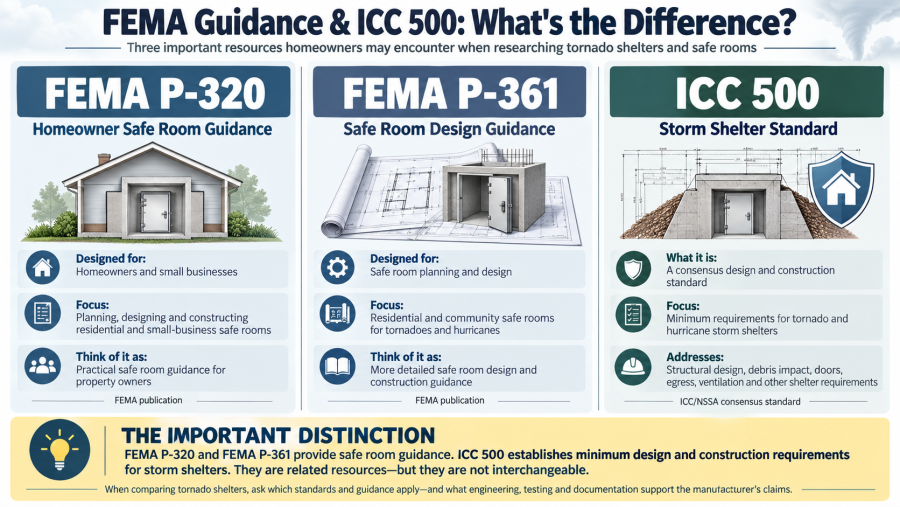
Homeowners frequently hear FEMA P-320, FEMA P-361 and ICC 500 mentioned together.
They are related, but they serve different purposes.
FEMA P-320
FEMA P-320, Taking Shelter from the Storm, provides guidance for homeowners and small businesses interested in constructing or installing a safe room.
FEMA P-361
FEMA P-361, Safe Rooms for Tornadoes and Hurricanes: Guidance for Community and Residential Safe Rooms, provides more extensive guidance covering the planning, design, construction and operation of safe rooms.
ICC 500
ICC 500 is a consensus standard containing minimum requirements for the design and construction of storm shelters.
FEMA's current P-361 guidance specifically references ICC 500-2023 as a companion standard.
The terminology matters because a manufacturer should be able to explain what criteria apply to its shelter and what documentation supports its claims, rather than relying on a vague statement that the product “meets FEMA.”
There Is No Such Thing as a FEMA-Approved Tornado Shelter Product
This is one of the most important things a homeowner can understand when comparing tornado shelters.
FEMA does not maintain a list of FEMA-approved tornado shelters.
FEMA also does not endorse, approve, certify or recommend individual contractors, manufacturers or products.
That means a homeowner who sees phrases such as:
- “FEMA approved”
- “FEMA certified”
- “Government approved shelter”
should ask the seller to explain exactly what is meant by the claim.
A more useful question is:
“What standard was this shelter designed and tested to meet, and can I see the supporting documentation?”
Why Tornado Shelter Testing Matters
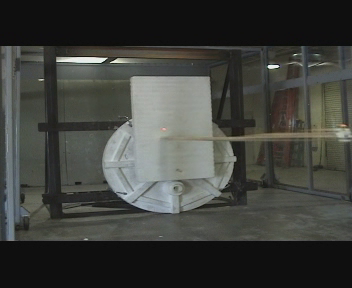
Tornadoes can turn ordinary objects into dangerous windborne debris.
That makes impact resistance a critical part of storm shelter design.
Testing isn't merely about determining whether a wall material is strong. Critical components and assemblies—including doors and locations where different components come together—can play an important role in the overall performance of a storm shelter.
A homeowner evaluating a shelter should ask:
- What testing has been performed?
- Who performed the testing?
- What standard or criteria were used?
- Was the complete shelter assembly evaluated or only individual materials?
- Was the door assembly included?
- Is documentation available?
A photograph of a strong-looking shelter is not a substitute for engineering and testing documentation.
Homeowners researching Granger ISS can view tornado shelter testing and impact-test videos as part of their research.
Why the Tornado Shelter Door Deserves Special Attention
A storm shelter is a system, and the door is one of its most important components.
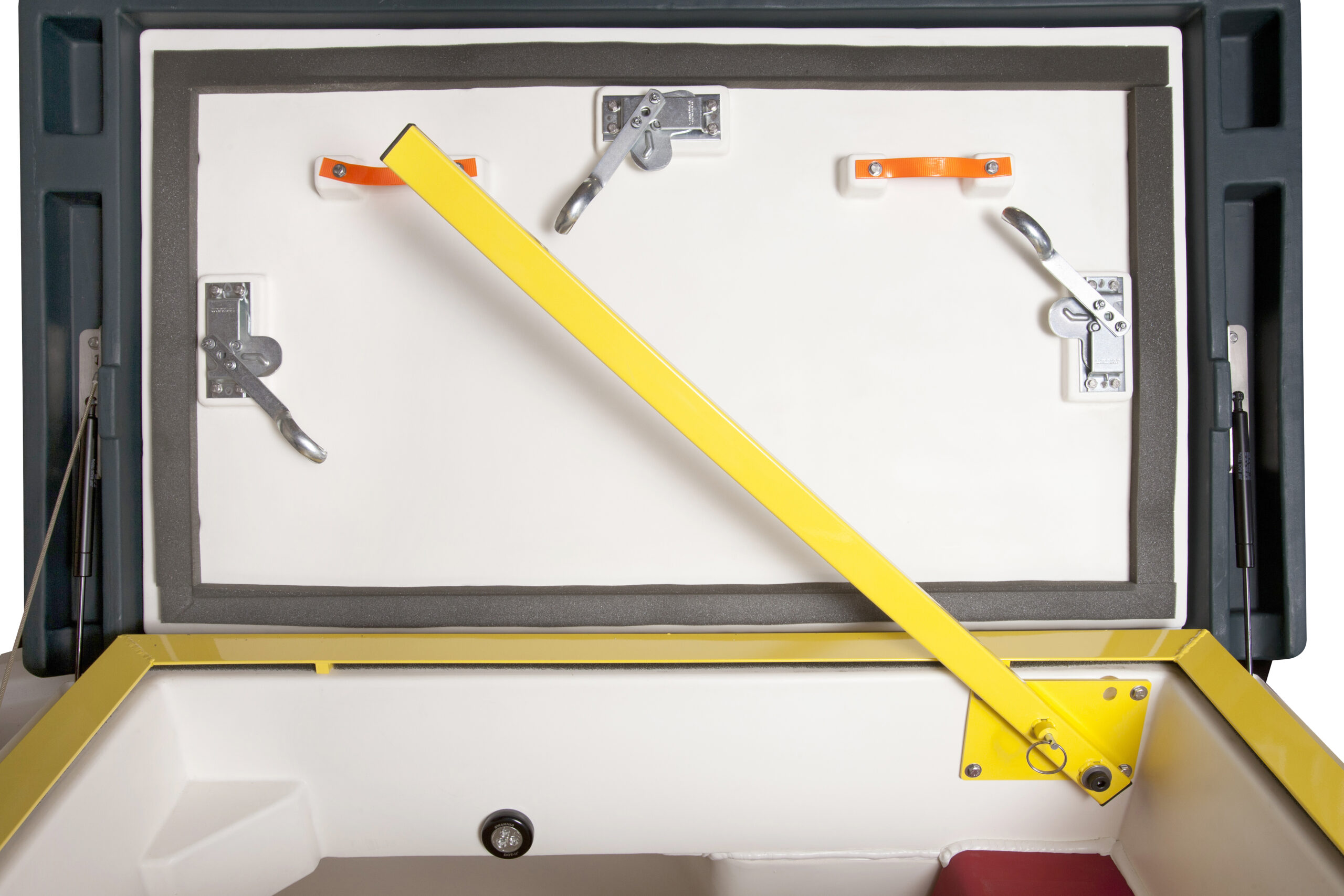
Homeowners should ask about the complete door assembly, including its construction, hinges, latching or locking system, hardware and applicable testing.
They should also understand how the door operates from inside the shelter and how household members will enter, secure and exit the shelter.
You can review the Granger ISS tornado shelter door, three-point locking system and other shelter features in more detail.
Installation Is Part of the Tornado Shelter System
Even a shelter designed around recognized criteria must be installed appropriately for its intended use.
Installation considerations can include:
- Foundation or soil conditions
- Anchoring
- Concrete requirements
- Placement and accessibility
- Drainage and flood considerations
- Local permits and inspections
- Manufacturer installation requirements
FEMA's consumer guidance specifically notes that a product must be properly installed for its intended use.
That is why homeowners should investigate both the shelter and the company responsible for installing it.
Before choosing an installer, review 8 things every homeowner should verify before hiring a tornado shelter contractor .
Professional Buyers Don't Rely on “Tornado Rated” Alone
One useful way for homeowners to understand the importance of specifications is to look at how sophisticated institutional buyers approach storm shelter projects.
A recent project solicitation for residential housing at Vance Air Force Base in Enid, Oklahoma called for the installation of 158 prefabricated storm shelters.
The project documentation didn't simply request shelters advertised as “tornado proof.” It identified specific technical requirements, including references to FEMA P-320 and ICC 500, along with requirements involving wind and missile-impact performance, installation, site work and technical documentation.
Homeowners obviously aren't writing military construction specifications when purchasing a residential shelter.
But the underlying principle is useful:
Don't buy based solely on a label. Ask what standards apply, what testing was performed, how the shelter will be installed and what documentation supports those claims.
New Shelter Technologies Still Have to Prove Their Performance
Storm shelter technology continues to evolve.
Researchers at Kansas State University, working with collaborators at Iowa State University, are currently investigating whether modular 3D-printed concrete construction could provide storm shelter options for manufactured-home communities.
The research is exploring variables such as print orientation, internal geometry, extreme wind pressure and debris impact.
Importantly, the research process illustrates an essential point for consumers: an innovative material or impressive design concept is not the end of the engineering process.
The researchers are moving toward full-scale testing under tornado conditions, including debris-impact testing.
That's how responsible engineering progresses:
Design → Analysis → Prototype → Testing → Evidence.
The lesson isn't that homeowners should prefer one shelter material over another. It's that claims about storm-shelter performance should be supported by appropriate engineering, testing and documentation.
ICC 500 Continues to Evolve
Storm shelter standards are not frozen in time.
The International Code Council is currently working through technical revisions associated with development of the 2026 edition of ICC 500.
The International Code Council is currently developing technical revisions for the 2026 edition of ICC 500 through its standards-development and public-review process.
That does not mean existing storm shelters suddenly became noncompliant or unsafe.
It means the technical standards used by engineers, code officials, manufacturers and other professionals continue to evolve as research, testing and real-world experience advance.
For homeowners, this reinforces the value of asking manufacturers:
“Which edition of the standard are you referencing?”
7 Questions to Ask When Someone Says a Tornado Shelter Is “FEMA Approved”
- What exactly do you mean by “FEMA approved”?
- What recognized standard or FEMA guidance was the shelter designed to meet?
- Which edition of ICC 500 applies to the claim?
- What testing was performed, and by whom?
- Was the door assembly included in the testing or evaluation?
- Can I review the engineering or testing documentation?
- What installation requirements must be followed for the shelter to perform as intended?
If a seller cannot clearly explain these questions, homeowners should consider doing additional research before purchasing.
Documentation Matters More Than Marketing Language
Most homeowners will never become storm-shelter engineers—and they shouldn't have to.
But consumers can ask informed questions.
When comparing a tornado shelter or storm shelter, look beyond phrases such as “heavy duty,” “tornado proof,” “tested” or “FEMA approved.”
Ask what standards apply. Ask about testing. Ask about the door. Ask about installation. Ask who performed the engineering. Ask for documentation.
Good manufacturers should be prepared to answer good questions.
FREE Tornado Shelter Buyer's Checklist
Take the questions with you before you buy. Granger ISS created a printable Tornado Shelter Buyer's Checklist to help homeowners compare shelters, manufacturers, installers and quotes.
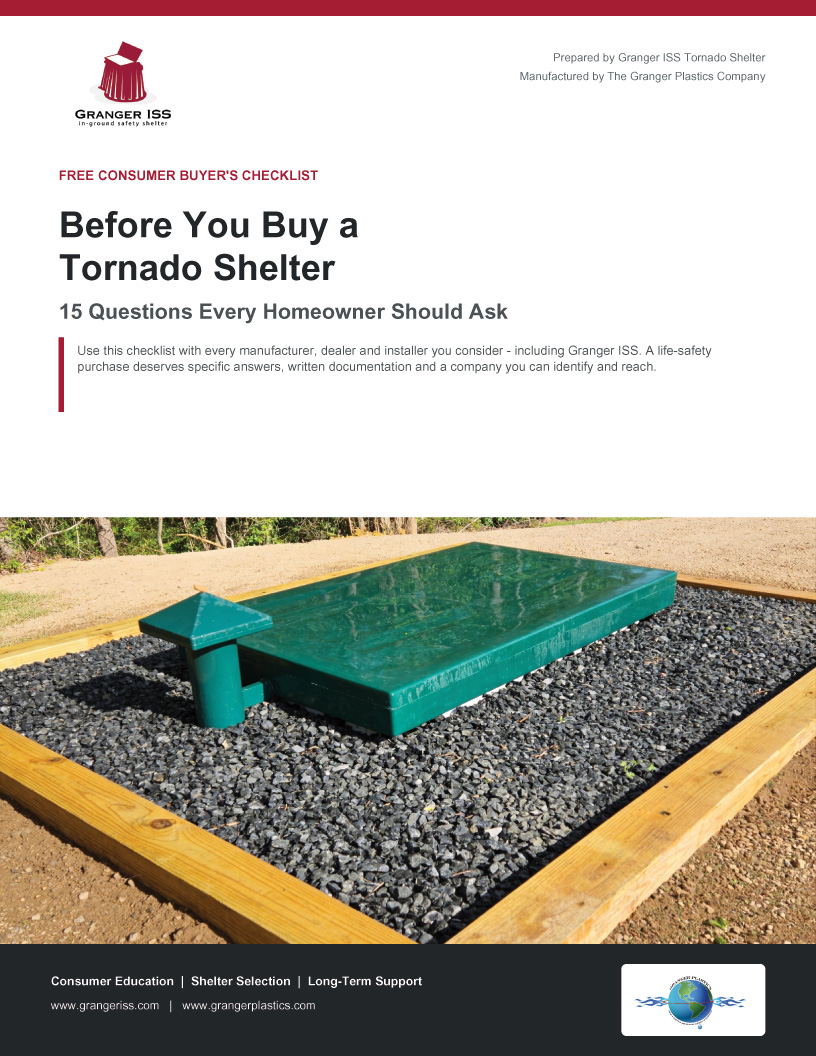
Enter your email below for immediate access. We'll also email you a copy so you can keep it while researching tornado shelters.
Research Before You Buy a Tornado Shelter
A residential tornado shelter is a long-term safety investment. Take the time to understand the product, manufacturer, installation and documentation before making a decision.
For a broader purchase guide, review questions every homeowner should ask before buying a tornado shelter .
Learn more about Granger ISS residential tornado shelters
This article is provided for general consumer education and is not engineering, building-code or legal advice. Applicable building codes, standards and installation requirements can vary by jurisdiction and project. Consult current FEMA guidance, applicable codes, local authorities having jurisdiction and qualified design professionals as appropriate.
DON’T STOP AT “IT’S TESTED.”
Ask what was tested, where it was tested, what criteria were used — and whether you can see the evidence.
The Granger ISS Tornado Shelter door underwent debris-impact testing at Texas Tech University.
WATCH THE TEXAS TECH IMPACT TEST